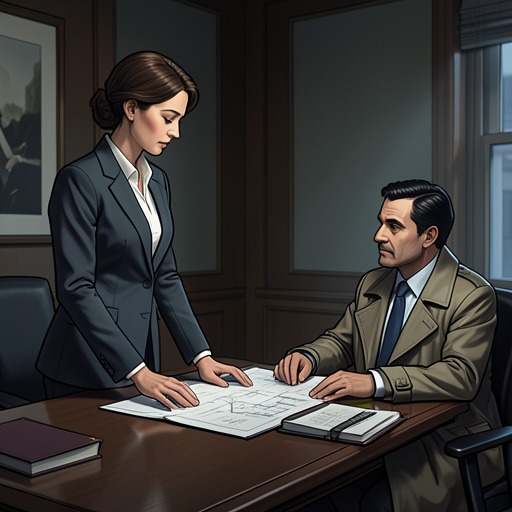
Byron and Fiffany’s relationship
Made for LoveByron Gogol and Fiffany Leiber’s relationship becomes both a personal partnership and a public instrument: their marriage is promoted as a love story, while its aftermath leaves Fiffany positioned to lead Gogol. The novel keeps the private nature of their bond uncertain, setting Byron’s public confidence in her against the company’s commercial interests, the constrained words she speaks, and Hazel Green’s suspicion about his death.
From Colleague to Public Partner
After Hazel Green disappears, Byron appears on camera discussing the loss and his expectation that she will be found. During the interview, the interviewer notes that Byron has filed for an abandonment divorce and introduces Fiffany Leiber as one of his project managers. Fiffany is present beside the public account of his marriage’s collapse, a colleague made visible as part of the supportive professional world he describes.
Byron says that he surrounds himself with energetic, imaginative, fearless people, and his eyes seem to move briefly toward Fiffany in a shared glance. The moment suggests an understanding between them, but does not establish what either privately feels. In the scene, their connection is legible first as workplace proximity and public alignment: Fiffany is a manager on his team, and Byron invokes the team’s fearlessness while addressing a question about coping with Hazel’s disappearance.
Marriage as a Marketed Story
Six months later, Byron and Fiffany marry in a ceremony described as more public and more heavily promoted than Byron and Hazel’s wedding. The contrast is pointed: rather than foregrounding technology, the new couple sells their love story, in the expectation that a public willing to buy that narrative will also buy what Byron sells next. Their marriage is therefore presented not only as a change in Byron’s personal life but also as an extension of his company’s approach to promotion and public belief.
Fiffany’s interviews complicate the polished image. When asked about a honeymoon, she describes an unusual fear involving people in wet bathing suits and the possibility of getting pool water on her own dry suit. Hazel recognizes the account as something she herself had once said to Byron during their marriage. Fiffany’s speech is governed by an agreement under which the only sentences she can utter publicly are sentences Hazel had previously said to him. The restriction makes the couple’s public intimacy difficult to read as spontaneous: Fiffany appears in the role of Byron’s wife, but the words audiences hear carry the trace of his former marriage.
Hazel understands this arrangement as part of her punishment. The evidence establishes the restrictive agreement and its effect on Fiffany’s public speech, but does not fully explain how it was made or what Fiffany privately thought of it. That limit matters: Fiffany is at once Byron’s publicly presented partner and a person whose available public language has been circumscribed by material from Hazel’s relationship with him. Their marriage is visible everywhere in the media, yet the public performance does not disclose the terms of their private relationship.
The Bedroom Footage and Byron’s Death
After Byron dies, leaked footage from bedroom security cameras at The Hub reaches the media. It shows Byron and Fiffany lying side by side with sleep helmets on. Byron sits upright, appears distressed, and struggles with his helmet and chest; Fiffany removes her own helmet and tries to work out what is wrong. The recording turns their shared bedroom into public evidence, exposing a private moment through the surveillance system Byron had said was switched off at night.
The public account attributes the death to a malfunction that prevented Byron from removing his helmet, perhaps involving a technical failure affecting his brain waves. Hazel rejects that explanation. She reasons that the safeguards make an accidental malfunction implausible and concludes that Fiffany intentionally caused his death, believing Byron must have realized this before he died. The footage, as described, shows Fiffany responding to his distress; it does not independently prove Hazel’s accusation. The distinction between the recording and Hazel’s interpretation leaves the circumstances unresolved for the reader.
Hazel’s response is divided. She finds some relief in the fact that the wider public believes Byron died because of an error in technology he created, but she also wishes the explanation were true. In her account, Fiffany’s action would mean that Byron did not die because his system failed; it would mean someone had outmaneuvered him. The uncertainty around Fiffany and Byron’s final hours therefore also bears on how the story judges the power Byron built around technological control.
Succession and the Meaning of the Partnership
Hazel suspects Fiffany may also have helped leak the footage. She does not present this as established fact: she considers the possibility that a worker would fear a lawsuit from Gogol and reads the leak as something that might function as an apology directed specifically to her. Jasper raises a toast to the new chief executive, and the news reports that Fiffany is expected to take the role while requesting privacy during the difficult period.
The reported succession changes the apparent balance between romance and ambition. Hazel decides she had misread Fiffany’s ultimate pursuit: in Hazel’s interpretation, Fiffany wanted the company rather than Byron. This remains Hazel’s conclusion, not a confirmed account of Fiffany’s motives. Yet the leadership news lends it weight within the narrative. Fiffany is not simply the surviving wife presented in public coverage; she is also poised to inherit authority over the enterprise around which Byron organized his identity and work.
Early speculation about Fiffany’s leadership describes possible withdrawal from several weapons contracts and greater investment in humanitarian initiatives, including art and education technologies. These are projected changes, not completed reforms, and the reporting does not establish what Fiffany will ultimately do. Still, the absence of brain melds from the anticipated initiatives marks a significant contrast with the company’s prior direction. The relationship’s ending thus carries a corporate consequence: Fiffany’s partnership with Byron ends with his death, but her position within Gogol may redirect what the company chooses to build and sell.
The novel leaves the relationship suspended between public image and private uncertainty. Byron and Fiffany’s wedding is marketed as a love story; Fiffany’s interview language is restricted by words borrowed from Hazel; and the footage of Byron’s final night invites interpretations it cannot settle. Fiffany’s possible ascent from project manager and wife to chief executive gives the partnership a political and commercial afterlife, even as the evidence stops short of confirming either her motives or her responsibility for Byron’s death.